

In the fast-paced world of digital marketing, finding the right search terms is the foundation of every successful campaign. Whether you are a small business owner, a niche blogger, or an agency executive, you need reliable data to drive your content strategy. This is where modern mobile-first SEO tools come into play. If you have been searching for a reliable keyword keyword planner appkod solution, you already know that staying ahead of the competition requires more than just guessing what your audience wants to read.
Search Engine Optimization (SEO) has evolved significantly. Today, search engines prioritize user intent, semantic relevance, and highly authoritative content. To meet these demands, you need a robust keyword tool that fits in your pocket, offers real-time data, and simplifies complex metrics. The Appkod keyword planner is designed to do exactly that. It bridges the gap between complicated desktop software and the need for agile, on-the-go SEO insights.
In this comprehensive guide, we will explore everything you need to know about this powerful tool. We will break down its core features, compare it to traditional desktop platforms, and provide a step-by-step framework to help you uncover hidden, high-converting search terms.
What is the Keyword Keyword Planner Appkod?
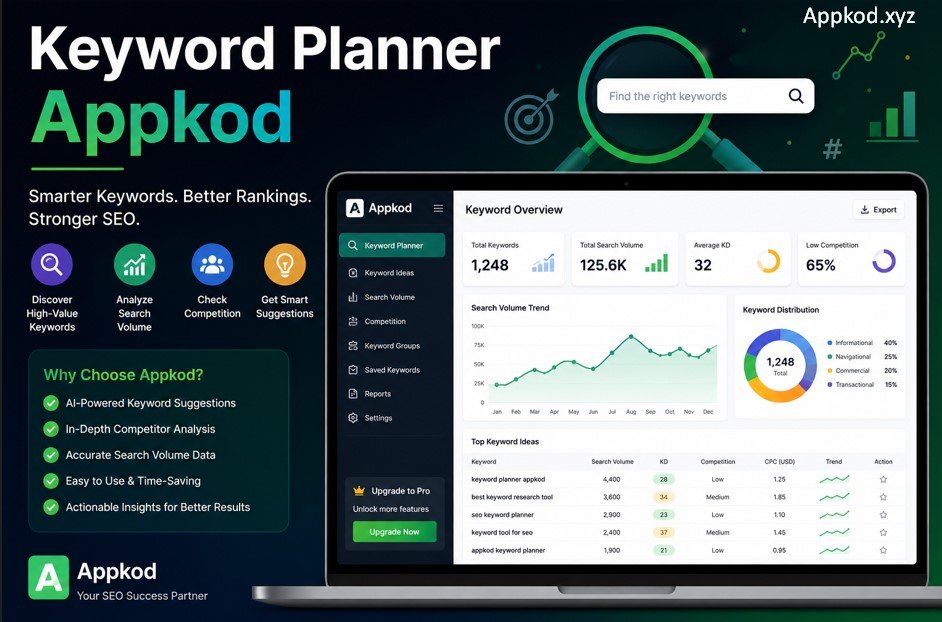
The keyword keyword planner appkod refers to a specialized mobile application designed to streamline the SEO keyword research process. Unlike heavy desktop applications that require a steep learning curve and constant browser refreshing, Appkod focuses on delivering precise, actionable data directly to your smartphone or tablet.
At its core, this planner helps webmasters and content creators discover exactly what their target audience is typing into search engines like Google and Bing. It analyzes billions of data points to provide metrics such as monthly search volume, competition levels, and cost-per-click (CPC) estimates.
More importantly, the app is built for speed. When inspiration strikes—perhaps during a commute or a client meeting—you can instantly validate a content idea without waiting to boot up a laptop. By offering a clean, intuitive interface, Appkod removes the friction from SEO planning, making it accessible even to beginners while retaining the depth required by seasoned professionals.
Why You Need a Dedicated Keyword Planner App
The days of restricting digital marketing tasks to a desktop computer are over. Modern marketers are constantly moving, and their tools need to move with them. Using a dedicated mobile application for keyword research offers several distinct advantages that traditional browser-based tools simply cannot match.
Mobile SEO Research
Inspiration does not run on a 9-to-5 schedule. You might notice a trending topic while scrolling through social media or overhear a common customer pain point while standing in line for coffee. A mobile-first keyword planner allows you to instantly verify if that topic has enough search demand to warrant a blog post or a new product page.
By having your SEO data accessible via an app, you eliminate the delay between ideation and validation. You can capture, analyze, and save keyword clusters directly to your mobile device, ensuring that no great content idea slips through the cracks.
Competitor Analysis on the Fly
Understanding what your competitors are ranking for is crucial for dominating search engine results pages (SERPs). With a dedicated app, you can perform quick competitor audits from anywhere. If a competitor launches a new landing page, you can immediately plug their URL into the app to see which search terms they are targeting.
This real-time competitive intelligence allows you to pivot your own strategy instantly. You can identify content gaps in their articles and quickly assign your freelance writers or internal team to create a better, more comprehensive piece of content before the competitor solidifies their ranking.
Key Features of Appkod for Keyword Research
To truly understand the value of this application, we must look under the hood at the specific tools it provides. A great keyword tool is only as good as the accuracy and depth of its data. Here are the standout features that make this app a must-have for digital marketers.
Accurate Search Volume Data
The most fundamental metric in SEO is Search Volume, which indicates how many times a specific phrase is searched per month. Appkod pulls data from highly reliable databases to give you an accurate picture of a keyword’s popularity.
Furthermore, the app provides historical trends. This means you can see if a keyword is gaining popularity over time or if it is a seasonal trend that only spikes during certain months (like “Christmas gift ideas” or “summer pool maintenance”). Knowing the trajectory of a keyword prevents you from investing time into declining topics.
Keyword Difficulty (KD) Scoring
Finding a keyword with high search volume is great, but it is useless if the competition is too fierce for your website to rank. Appkod features a proprietary Keyword Difficulty (KD) score, usually ranked on a scale from 1 to 100.
- 1–30: Easy to rank. Perfect for new websites with low domain authority.
- 31–60: Medium difficulty. Requires quality content and a few solid backlinks.
- 61–100: Hard to rank. Dominated by massive brands and household names.
By utilizing this feature, you can target the “low-hanging fruit”—keywords with decent volume but low difficulty—allowing you to secure organic traffic much faster.
LSI and Semantic Suggestions
Search engines no longer rely on exact-match keywords. They use Natural Language Processing (NLP) to understand the context of an article. Appkod excels at providing Latent Semantic Indexing (LSI) keywords.
These are conceptually related terms that help search engines understand your topic. For example, if your primary keyword is “apple,” LSI keywords like “nutrition,” “orchard,” and “recipe” tell Google you are talking about the fruit, whereas “iPhone,” “MacBook,” and “iOS” indicate you are writing about the tech company. Including these semantic suggestions naturally in your writing boosts your topical authority.
How to Use Appkod for SEO Success

Having a powerful tool is only half the battle; knowing how to wield it is what separates average marketers from industry leaders. Here is a proven, step-by-step workflow for extracting the best data from the app.
Step 1: Brainstorming Seed Terms
Every keyword strategy begins with a seed keyword. This is a broad, one-to-two-word phrase related to your business. Open the app and type in a seed term. For instance, if you run a fitness blog, your seed term might be “weight loss” or “home workouts.”
The app will generate hundreds, sometimes thousands, of related long-tail keywords. Long-tail keywords are longer, more specific phrases (e.g., “best home workouts for bad knees”). They usually have lower search volume but incredibly high conversion rates because the user’s intent is so specific.
Step 2: Filtering by Search Intent
Not all keywords are created equal. You must align the keyword with the correct Search Intent. Appkod often categorizes keywords into four main buckets:
- Informational: The user wants to learn something (e.g., “how to tie a tie”).
- Navigational: The user is looking for a specific website (e.g., “Facebook login”).
- Commercial: The user is researching before buying (e.g., “Mailchimp vs Constant Contact”).
- Transactional: The user is ready to buy right now (e.g., “buy Nike running shoes size 10”).
Use the app’s filters to isolate informational keywords for your blog posts and transactional keywords for your product or service pages.
Step 3: Exporting Data for Campaigns
Once you have identified a cluster of low-difficulty, high-intent keywords, you need to move them into your production pipeline. Appkod allows you to easily select your chosen terms and export them via CSV or share them directly to cloud storage apps like Google Drive or Dropbox. You can then hand these optimized lists over to your content writers, complete with target search volumes and semantic LSI terms to include.
Appkod vs. Traditional Keyword Tools
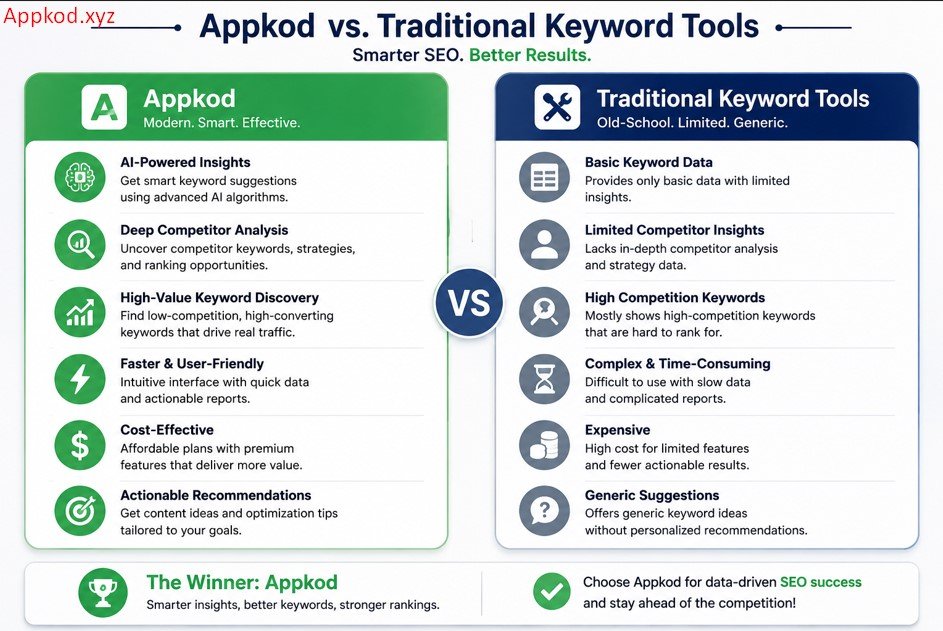
How does a mobile-focused application stack up against the industry giants that have dominated the desktop space for a decade? Let us look at a direct comparison to help you decide which fits your workflow best.
| Feature | Appkod Mobile Planner | Traditional Desktop Tools |
| Platform Focus | Mobile-first (iOS & Android) | Desktop browser-based |
| Accessibility | Instant access from anywhere | Requires a computer and setup |
| User Interface | Streamlined, minimalist, and fast | Complex, data-heavy, often cluttered |
| Learning Curve | Very low (Beginner friendly) | High (Requires SEO knowledge) |
| Pricing Model | Often highly affordable / One-time | Expensive monthly subscriptions |
| Exporting | Direct to mobile cloud/email | Extensive CSV and API integrations |
As the table shows, desktop tools offer massive, exhaustive data suited for large enterprise agencies doing technical SEO audits. However, for content creators, small business owners, and agile marketers who need fast, accurate keyword generation without the bloat, the mobile approach is far more efficient.
Pros and Cons of Using Appkod

Every software has its strengths and limitations. Understanding these will help you integrate the app seamlessly into your daily marketing routine.
Pros:
- Ultimate Portability: Conduct research anywhere, anytime, without needing a laptop.
- Intuitive Design: The uncluttered interface prevents data paralysis.
- Cost-Effective: Generally much cheaper than the $100+ monthly fees charged by desktop SEO giants.
- Fast Loading: Optimized for mobile networks, returning search data in seconds.
- Actionable Metrics: Focuses strictly on the metrics that matter most (Volume, KD, CPC).
Cons:
- Screen Size Limitations: Analyzing massive spreadsheets of thousands of keywords is inherently difficult on a smartphone screen.
- Less Technical SEO Data: It may lack deep technical features like comprehensive backlink profile auditing or server log analysis.
- Battery Drain: Like any data-heavy mobile application, prolonged use can consume smartphone battery life.
Advanced Tips for Maximizing ROI

Once you have mastered the basics of the keyword keyword planner appkod, it is time to elevate your strategy. Here are three advanced tactics to get the highest return on investment from your research.
- Target Content Gaps Use the app to search for a competitor’s domain. Look closely at the keywords they rank for on page two or three of Google. These are their weaknesses. If you create a vastly superior, more updated piece of content targeting those exact same terms, you can easily outrank them and steal their traffic.
- Leverage Local SEO If you run a brick-and-mortar business, generic keywords will not help you. Use the app’s location filters to find local search volume. Instead of targeting “best coffee,” target “best coffee shop in downtown Chicago.” The search volume will be lower, but the foot traffic generated will be highly qualified.
- Build Topic Clusters Do not just write one article about a broad topic. Use the app to find 10 closely related long-tail keywords. Write one massive “Pillar” post covering the broad topic, and 10 smaller articles covering the specific long-tail keywords. Link all the smaller articles back to the pillar post. This creates a semantic cluster that proves to Google you are a deep subject matter expert.
Frequently Asked Questions (FAQs)
1. What exactly does a keyword planner do?
A keyword planner analyzes search engine data to tell you what phrases people are typing into Google. It reveals how many people search for a term, how hard it is to rank for it, and suggests related topics you might not have considered. This prevents you from writing content that nobody is looking for.
2. Is the keyword keyword planner appkod suitable for beginners?
Yes, absolutely. The primary advantage of this mobile application is its user-friendly interface. It strips away the overwhelming, overly technical graphs found in enterprise software and presents the most important data—volume and difficulty—in a clean, easy-to-read format.
3. How accurate is the Keyword Difficulty (KD) score?
The KD score is highly reliable as an estimation tool. It calculates difficulty based on the domain authority, backlink profiles, and content quality of the pages currently ranking on the first page of Google. While no tool is 100% perfect, sticking to keywords with a KD under 30 is a proven strategy for newer websites.
4. Can I use the app for local SEO campaigns?
Yes. Depending on the settings you configure, you can filter keyword search volume by specific countries, regions, and sometimes even cities. This is incredibly valuable for local businesses like plumbers, restaurants, and real estate agents who only want to attract traffic from their specific geographic area.
5. Does the app provide long-tail keyword suggestions?
Finding long-tail keywords is one of the tool’s strongest features. When you input a generic, highly competitive seed keyword, the app’s algorithm will automatically generate hundreds of longer, hyper-specific variations that are much easier to rank for and convert at a higher rate.
6. How does mobile keyword research differ from desktop research?
The data itself is largely the same, but the workflow is completely different. Mobile research allows for instant validation of ideas while on the go. It is designed for speed and agility, allowing you to capture ideas, check their viability instantly, and save them to a cloud list before the idea is forgotten.
7. Can I export my keyword lists to share with my writing team?
Yes, you can easily select your favorite keywords and export the lists as CSV files. These files can then be emailed directly from your phone or uploaded to shared workspaces like Google Sheets, ensuring seamless collaboration with your freelance writers or in-house content team.
8. Does the app show search intent?
While search intent is partially subjective, the app helps identify it by showing you the Cost-Per-Click (CPC) metrics. A high CPC usually indicates Commercial or Transactional intent because advertisers are willing to pay money for those clicks. Lower CPCs usually point toward Informational intent.
9. Will using this tool guarantee a number-one ranking on Google?
No tool can guarantee a number-one ranking. SEO is a combination of proper keyword research, exceptional content writing, technical website health, and high-quality backlinks. However, using this tool ensures you are pointing your efforts in the right direction, drastically increasing your chances of ranking on page one.
10. How often should I perform keyword research?
Keyword research should be an ongoing habit. Search trends change constantly based on seasons, news cycles, and cultural shifts. It is highly recommended to perform fresh keyword research at least once a month to keep your content calendar full of relevant, high-traffic topics.
Conclusion
Succeeding in organic search requires strategy, agility, and accurate data. Relying on guesswork to plan your content calendar is a surefire way to waste time and resources. By integrating the keyword keyword planner appkod into your daily marketing routine, you empower yourself with real-time, actionable insights right from your smartphone.
From identifying long-tail, low-competition phrases to analyzing the exact search intent of your target audience, a dedicated mobile planner removes the friction from traditional SEO workflows. It allows you to strike while the iron is hot, validating content ideas the moment they occur to you.
Start treating your keyword research as an ongoing, dynamic process rather than a static monthly chore. By leveraging the accuracy, speed, and semantic suggestions provided by modern mobile SEO tools, you will consistently publish content that Google loves to rank and your audience loves to read. Embrace the mobile SEO revolution today, and watch your organic traffic soar.