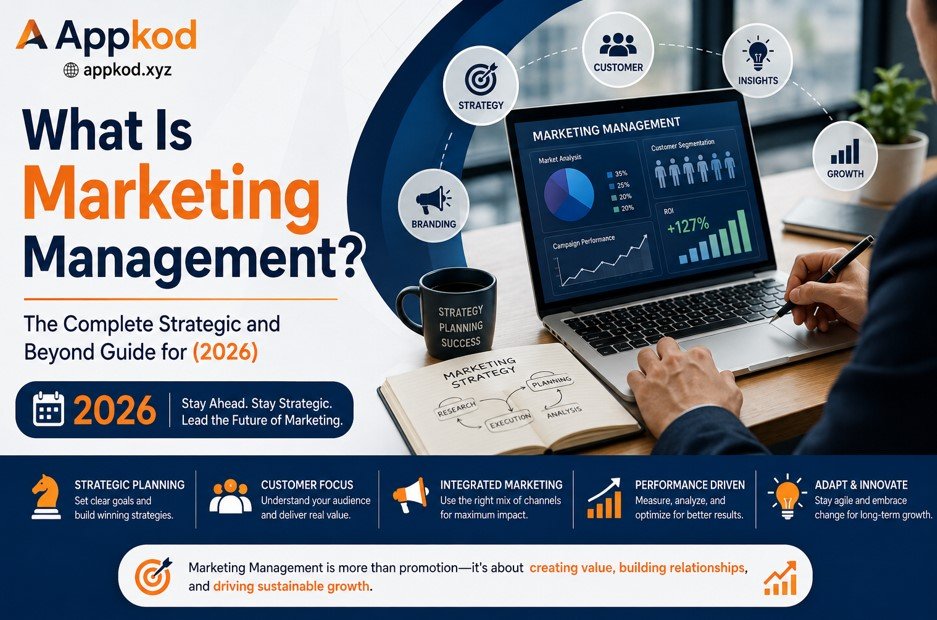
Every successful business has one thing in common: someone is steering the marketing ship.
That’s marketing management. It’s the process of planning, organizing, and controlling a company’s marketing efforts to reach the right people at the right time.
Without it, even the best product can sit on a shelf unnoticed. With it, a small brand can outgrow giants with far bigger budgets.
In this guide, you’ll learn what marketing management actually involves, the frameworks top companies use, and how to apply these ideas in your own business — no matter its size.
1. What Is Marketing Management?

Marketing management is the discipline of planning, executing, and analyzing marketing programs to meet business goals. It covers everything from market research to pricing, promotion, and customer retention.
Think of it as the bridge between what a company makes and what customers actually want.
A marketing manager doesn’t just “run ads.” They study buyer behavior, forecast demand, allocate budgets, and measure results against clear targets. This makes marketing management both an art and a science — creativity guided by data.
The concept isn’t new. Philip Kotler, often called the father of modern marketing, defined it decades ago as the analysis, planning, implementation, and control of programs designed to build profitable exchanges with target buyers. That definition still holds true today, even as the tools have changed dramatically.
2. Why Marketing Management Matters

Businesses that treat marketing as an afterthought usually struggle to grow. Here’s why structured marketing management makes a measurable difference:
- It aligns marketing with business goals. Every campaign ties back to revenue, growth, or brand objectives.
- It reduces wasted spend. Budgets go toward channels that actually convert.
- It builds long-term brand equity. Consistent messaging creates trust over time.
- It improves customer retention. Good marketing management doesn’t stop at the sale — it nurtures loyalty.
- It creates accountability. Clear KPIs mean teams know what success looks like.
Companies without a marketing management system often chase trends instead of building a sustainable growth engine. That’s the core difference between random acts of marketing and a real strategy.
Consider two companies selling similar products. One launches campaigns whenever inspiration strikes, with no clear budget or measurement plan. The other follows a structured process: research, plan, execute, measure, refine. Over a year, the second company almost always outperforms the first, even with a smaller ad spend, because every dollar is working toward a defined outcome.
This is especially true in competitive markets, where customer attention is scarce and expensive to earn. Structured marketing management helps businesses cut through noise instead of adding to it.
3. Core Functions of Marketing Management
Marketing management isn’t one task — it’s a collection of interconnected functions working together.
Market Research and Analysis
Understanding customer needs, competitor positioning, and market trends before making decisions.
Product Management
Guiding product development based on what the market actually wants, not just internal assumptions.
Pricing Strategy
Setting prices that reflect value, competition, and profitability goals.
Promotion and Communication
Choosing the right mix of advertising, content, PR, and social media to reach target audiences.
Distribution Management
Deciding how and where products or services reach customers, whether online, in-store, or through partners.
Performance Measurement
Tracking KPIs like customer acquisition cost (CAC), return on ad spend (ROAS), and lifetime value (LTV) to refine future decisions.
Customer Relationship Management
Building systems to nurture leads, retain existing customers, and turn buyers into repeat customers or brand advocates.
Brand Positioning
Defining how the company wants to be perceived relative to competitors, and making sure every touchpoint reinforces that image consistently.
Each function feeds into the next. Poor research leads to poor pricing. Poor pricing undermines even the best promotion. And weak customer relationship management can undo the gains from a strong launch, since acquiring a new customer typically costs far more than retaining an existing one.
This interconnection is why marketing management works best as a coordinated system rather than a set of isolated tasks handled by different people with no shared vision.
4. The Marketing Management Process (Step-by-Step)
Here’s how the process typically unfolds in a well-run organization:
- Set clear objectives — Define what success looks like (sales growth, brand awareness, market share).
- Conduct market research — Study customers, competitors, and industry trends.
- Segment the target audience — Group customers by demographics, behavior, or needs.
- Develop the marketing mix — Plan product, price, place, and promotion (the classic 4Ps).
- Create a budget — Allocate resources across channels based on expected ROI.
- Execute campaigns — Launch content, ads, and outreach across chosen platforms.
- Monitor performance — Track metrics in real time using analytics tools.
- Optimize and adjust — Refine campaigns based on what the data shows.
This cycle repeats continuously. Marketing management is never truly “finished” — it evolves as markets and customer behavior shift.
5. Popular Marketing Management Frameworks
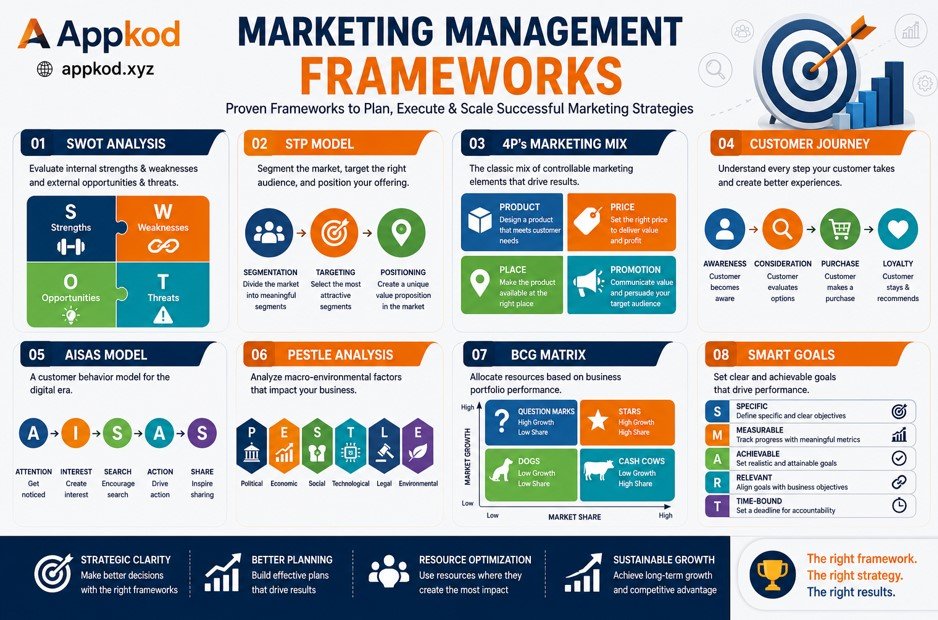
Several frameworks help marketers structure their thinking. Each serves a different purpose.
The 4Ps of Marketing
Product, Price, Place, Promotion — the foundational model for planning any offering.
The 7Ps (Extended for Services)
Adds People, Process, and Physical Evidence, useful for service-based businesses like SaaS or consulting.
SWOT Analysis
Evaluates Strengths, Weaknesses, Opportunities, and Threats before setting strategy.
STP Model
Segmentation, Targeting, and Positioning — helps identify who to sell to and how to stand out.
AIDA Model
Attention, Interest, Desire, Action — maps the customer journey from awareness to purchase.
Choosing the right framework depends on your industry, business stage, and goals. Many marketing managers combine two or three frameworks for a fuller picture.
For example, a new SaaS company might start with a SWOT analysis to understand its competitive position, use STP to identify the most profitable customer segment, and then apply AIDA when designing landing pages and email sequences. No single framework covers everything, which is why flexibility matters more than rigid adherence to any one model.
It’s also worth noting that frameworks are tools, not rules. They exist to organize thinking, not replace judgment. A framework that doesn’t fit your business or industry should be adapted rather than forced.
6. Marketing Management vs. Marketing Strategy
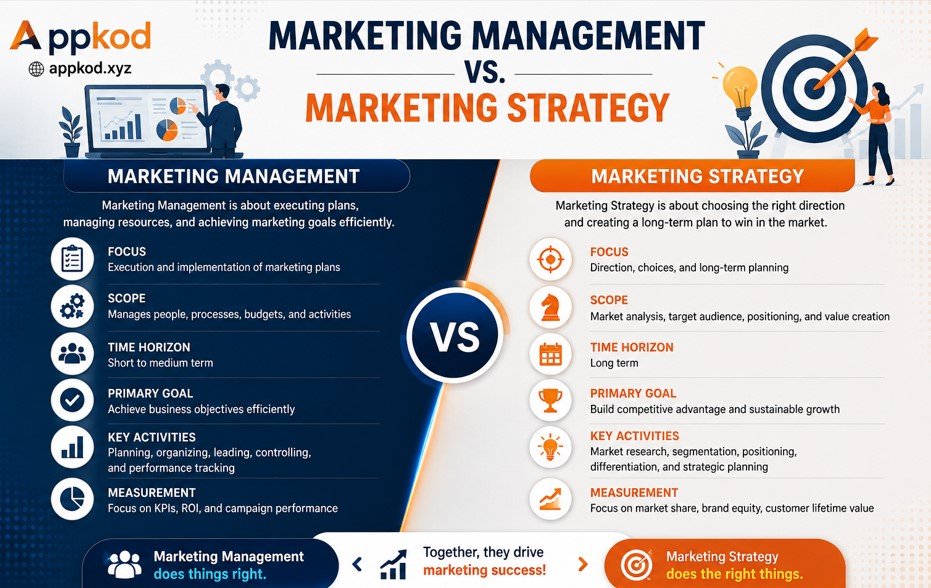
These terms often get confused, but they’re not the same thing.
| Aspect | Marketing Management | Marketing Strategy |
| Definition | The ongoing process of executing and controlling marketing activities | The long-term plan defining direction and positioning |
| Focus | Day-to-day operations and coordination | Big-picture goals and competitive positioning |
| Time Frame | Continuous, operational | Typically annual or multi-year |
| Output | Campaigns, budgets, reports | Vision, target market, brand positioning |
| Owner | Marketing managers and teams | Senior leadership or CMOs |
In short, strategy sets the direction. Management makes sure the ship actually gets there.
7. Skills Every Marketing Manager Needs
Great marketing managers combine analytical thinking with creative instinct. Key skills include:
- Data analysis — Reading campaign performance and customer analytics.
- Communication — Presenting ideas clearly to stakeholders and teams.
- Budget management — Allocating resources efficiently across channels.
- Digital literacy — Understanding SEO, paid ads, email, and social platforms.
- Consumer psychology — Knowing what drives buying decisions.
- Project management — Coordinating campaigns across multiple teams and deadlines.
- Adaptability — Adjusting quickly when trends or algorithms shift.
Employers increasingly value marketers who can move fluidly between creative and technical work, since modern campaigns rarely live in just one channel.
Beyond hard skills, emotional intelligence plays a bigger role than many people expect. Marketing managers often mediate between sales, product, and executive teams, each with different priorities. Being able to translate data into a story that resonates with each audience is what separates a good marketing manager from a great one.
8. Tools Used in Modern Marketing Management
Technology has transformed how marketing gets managed. Common tool categories include:
- Analytics platforms (Google Analytics, Looker Studio) — track website and campaign performance.
- CRM systems (HubSpot, Salesforce) — manage customer relationships and sales pipelines.
- Project management tools (Asana, Trello, Monday.com) — coordinate team workflows.
- Email marketing platforms (Mailchimp, ActiveCampaign) — automate customer communication.
- SEO tools (Ahrefs, SEMrush) — research keywords and monitor rankings.
- Social media schedulers (Buffer, Hootsuite) — plan and publish content across platforms.
The right stack depends on business size and budget, but most successful teams rely on at least one tool from each category to stay organized and data-driven.
9. Pros and Cons of Structured Marketing Management
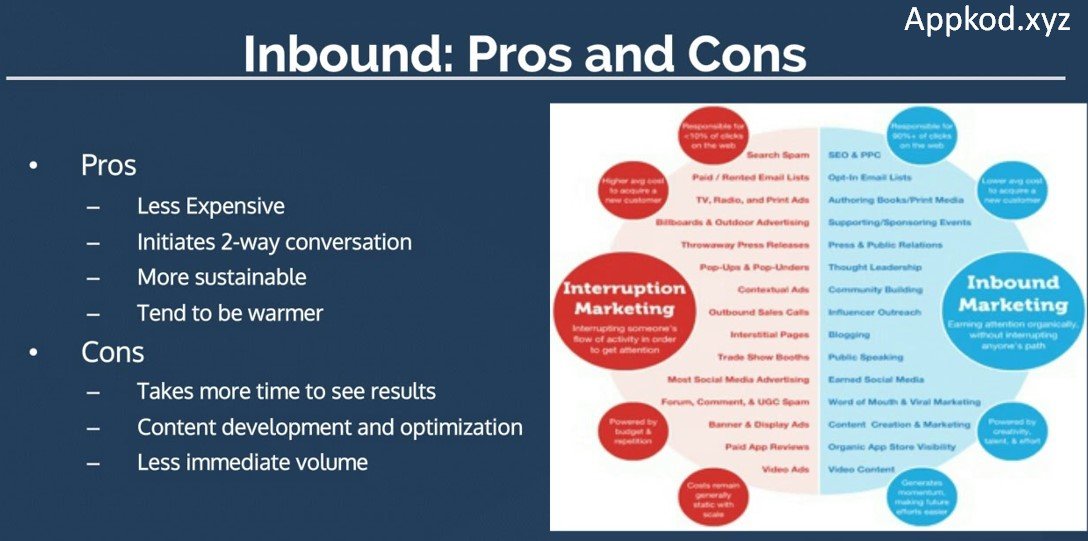
Pros
- Clear alignment between marketing efforts and business goals
- Better budget efficiency through data-driven decisions
- Easier to measure ROI and justify spend
- Stronger brand consistency across channels
- Improved team accountability and workflow
Cons
- Can become overly rigid if processes aren’t reviewed regularly
- Requires ongoing investment in tools and training
- Slower to adapt if approval layers are too heavy
- Risk of over-relying on data at the expense of creativity
Balancing structure with flexibility is the real challenge. The best marketing managers build systems that guide decisions without stifling new ideas.
10. Common Mistakes to Avoid
Even experienced teams fall into these traps:
- Ignoring customer feedback in favor of internal assumptions
- Chasing every new trend instead of building a consistent strategy
- Setting vague goals that can’t be measured
- Underinvesting in research before launching campaigns
- Failing to align sales and marketing teams, leading to mixed messaging
Avoiding these pitfalls often matters more than any single tactic. Consistency and clarity beat flashy, short-lived wins.
Another overlooked mistake is treating marketing management as a one-person job. Even in small businesses, involving customer service or sales in strategy conversations often surfaces insights that pure data can’t capture, like recurring objections or unexpected use cases for a product.
Frequently Asked Questions
1. What is the main goal of marketing management?
The main goal is to create, communicate, and deliver value to customers profitably while meeting business objectives.
2. Is marketing management the same as digital marketing?
No. Digital marketing is one channel within marketing management, which also covers offline promotion, pricing, product decisions, and distribution.
3. What qualifications do you need to work in marketing management?
Most roles require a background in business, marketing, or communications, though many professionals also succeed through hands-on experience and certifications.
4. How is marketing management different from sales management?
Marketing management focuses on attracting and engaging customers, while sales management focuses on converting leads into paying customers.
5. What is the marketing mix in marketing management?
The marketing mix refers to the 4Ps — Product, Price, Place, and Promotion — used to shape a company’s market offering.
6. Why is customer segmentation important in marketing management?
Segmentation helps businesses target the right audience with relevant messaging, improving conversion rates and reducing wasted ad spend.
7. What metrics do marketing managers track most often?
Common metrics include customer acquisition cost, conversion rate, return on ad spend, and customer lifetime value.
8. Can small businesses benefit from marketing management principles?
Yes. Even a solo entrepreneur benefits from basic research, budgeting, and performance tracking — the core of marketing management scales to any size.
9. How often should a marketing plan be reviewed?
Most businesses review and adjust their marketing plans quarterly, though fast-moving industries may need monthly check-ins.
10. What’s the difference between marketing management and brand management?
Marketing management oversees the full marketing process, while brand management focuses specifically on shaping perception and identity over time.
Conclusion
Marketing management turns scattered efforts into a coordinated growth engine. It combines research, strategy, execution, and measurement into one continuous cycle.
Whether you’re running a startup or managing a global brand, the fundamentals stay the same: understand your customer, deliver real value, and keep refining based on results.
Master these basics, and marketing stops feeling like guesswork — it becomes a reliable system for sustainable growth.
Start small if you need to. Pick one framework, define one clear goal, and track one set of metrics consistently. Over time, these small habits compound into a marketing function that drives real, measurable business results.