Every dollar you spend on marketing should bring something back. That’s the whole idea behind performance marketing. Unlike old-school advertising, where you pay for space and hope for the best, performance marketing ties your spending directly to results like clicks, leads, and sales.
A performance marketing agency builds and runs these results-driven campaigns for you. They use paid ads, data tracking, and constant testing to squeeze more value out of every marketing dollar. If you’re a business owner tired of guessing whether your ads actually work, this guide will help you understand what these agencies do and how to pick the right one.
We’ll walk through the core services, pricing models, red flags to avoid, and the exact questions to ask before you sign a contract. By the end, you’ll know exactly what “good” looks like in this industry.
1. What Is a Performance Marketing Agency?

A performance marketing agency is a specialized firm that manages paid digital campaigns based on measurable outcomes. Instead of billing you for vague “brand awareness,” they focus on numbers you can actually count: leads generated, cost per acquisition, return on ad spend, and revenue.
These agencies typically work across multiple channels, including:
- Google Ads and Microsoft Ads (search and shopping campaigns)
- Meta Ads (Facebook and Instagram)
- TikTok and YouTube advertising
- Affiliate and partner marketing
- Programmatic display advertising
- Email and SMS marketing automation
The word “performance” is the key. Everything the agency does gets measured against a specific goal. If a campaign isn’t hitting targets, the strategy gets adjusted or dropped. This makes performance marketing one of the most accountable forms of advertising available today.
2. How Performance Marketing Differs From Traditional Marketing

Traditional marketing, like billboards, TV spots, and print ads, focuses on reach and impressions. You pay upfront, and the results are hard to measure directly.
Performance marketing flips that model. Here’s how the two compare:
| Factor | Traditional Marketing | Performance Marketing |
| Payment model | Pay for space/time | Pay for actual results |
| Measurability | Difficult to track ROI | Fully trackable in real time |
| Flexibility | Locked-in campaigns | Adjustable daily or hourly |
| Best for | Long-term brand building | Lead generation and sales |
| Typical channels | TV, radio, print | Search, social, display, affiliate |
| Reporting | Limited or delayed | Live dashboards and analytics |
Both approaches have their place. Many businesses use traditional marketing for brand recognition and performance marketing for direct, trackable growth.
3. Core Services Offered by Performance Marketing Agencies
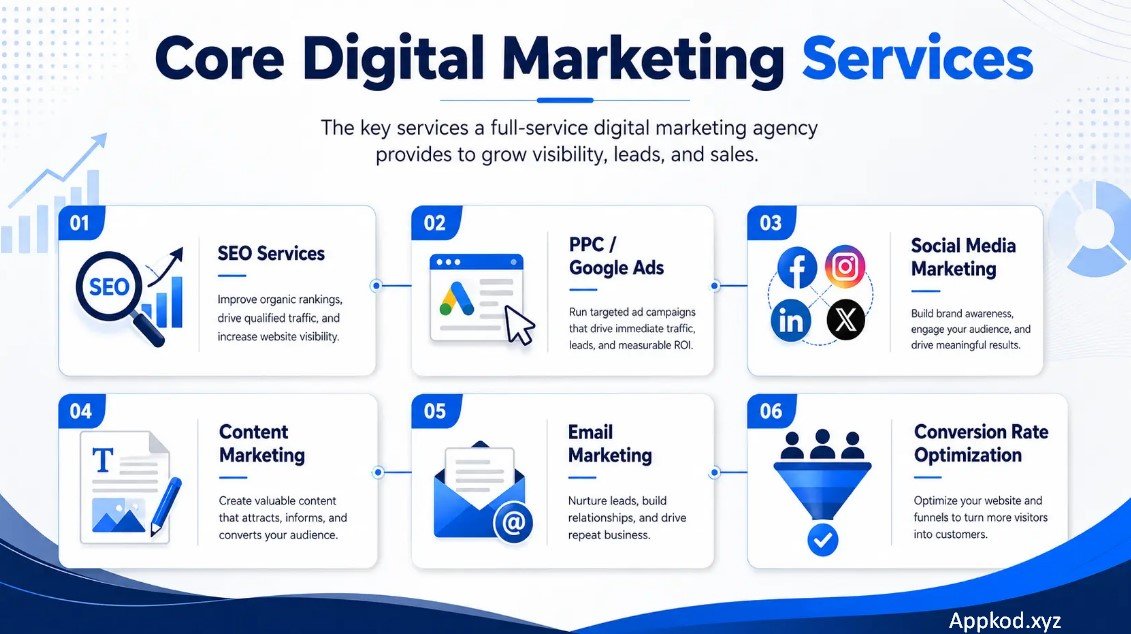
A strong agency won’t just run ads. They’ll manage the entire growth funnel. Here’s what that typically includes.
Paid Search Advertising (PPC)
This covers Google Ads and Bing Ads campaigns targeting people who are actively searching for your product or service. Good agencies focus on keyword research, ad copywriting, and bid management to keep your cost per click as low as possible.
Paid Social Advertising
Platforms like Facebook, Instagram, TikTok, and LinkedIn allow for precise audience targeting. Agencies build custom audiences based on interests, behaviors, and past interactions with your brand.
Conversion Rate Optimization (CRO)
Getting traffic is only half the job. CRO focuses on turning that traffic into paying customers through landing page testing, form optimization, and user experience improvements.
Analytics and Attribution
Data tracking tools like Google Analytics 4, server-side tracking, and custom dashboards help agencies see exactly which campaigns drive revenue, not just clicks.
Creative Production
Ad creative, including images, videos, and copy, gets tested constantly. Top agencies run A/B tests on multiple creative variations to find what resonates with your audience.
Marketing Automation
Email sequences, retargeting funnels, and SMS campaigns keep leads engaged after their first interaction, boosting lifetime customer value.
4. How Pricing and Fee Structures Work
Understanding how agencies charge helps you compare offers fairly. Most performance marketing agencies use one of these models:
- Percentage of ad spend: Typically 10–20% of your total monthly ad budget. This scales with your growth but can get expensive at larger budgets.
- Flat monthly retainer: A fixed fee, often between $2,500 and $15,000+ per month, depending on service scope.
- Performance-based fees: You pay based on results, like cost per lead or cost per sale. This aligns incentives but is less common for full-service work.
- Hybrid models: A smaller retainer plus a performance bonus once targets are hit.
There’s no single “correct” model. What matters is transparency. Ask exactly what’s included in the fee and what counts as an extra cost, like creative production or software tools.
5. Signs You Need a Performance Marketing Agency
Not every business needs outside help immediately. Here are clear signals it might be time to bring one in:
- Your ad spend is growing, but results aren’t improving
- You lack in-house expertise across multiple ad platforms
- Your team spends more time managing campaigns than analyzing them
- You’re launching in a new market and need fast, data-backed decisions
- Your current campaigns lack consistent testing and optimization
- You want to scale but don’t have the bandwidth to manage it internally
If two or more of these sound familiar, an agency partnership could pay for itself quickly.
6. In-House Team vs. Agency vs. Freelancer

Choosing how to structure your marketing function is a real decision. Here’s a quick breakdown to help you weigh the options.
| Option | Cost | Expertise Range | Scalability | Best For |
| In-house team | High (salaries + benefits) | Narrow unless team is large | Slower to scale | Large companies with steady budgets |
| Performance marketing agency | Medium to high | Broad, cross-channel | Fast to scale up or down | Growing businesses needing results fast |
| Freelancer | Low to medium | Limited to individual skillset | Hard to scale | Small budgets, single-channel needs |
Agencies typically offer the best balance between cost, expertise, and speed for businesses that are past the startup stage but not yet ready for a full internal team.
7. How to Choose the Right Agency

Picking the right partner takes more than a quick Google search. Follow this process to avoid costly mistakes.
Step 1: Define Your Goals First
Before contacting any agency, know your target cost per acquisition, revenue goals, and timeline. Agencies work better when given clear direction.
Step 2: Check Their Track Record
Ask for case studies in your industry or a similar business size. Real agencies will show actual numbers, not just vague success stories.
Step 3: Ask About Reporting Frequency
Weekly or biweekly reporting is standard for active campaigns. Monthly-only reporting can mean slower reaction times to underperforming ads.
Step 4: Understand Who Manages Your Account
Some agencies assign junior staff to smaller accounts. Ask directly who will handle your campaigns daily and their experience level.
Step 5: Review Contract Terms
Look closely at contract length, cancellation terms, and ownership of your ad accounts and data. You should always own your accounts, not the agency.
Step 6: Request a Trial Period or Pilot Campaign
Many agencies offer a 60–90 day trial. This lets you evaluate their process before committing to a long-term contract.
8. Red Flags to Watch For
Watch out for these warning signs during your search:
- Guarantees of specific rankings or results without context
- Vague reporting that doesn’t tie back to revenue
- Long-term contracts with heavy cancellation penalties
- Lack of transparency about who owns your data and ad accounts
- Overreliance on one platform instead of a diversified strategy
- No clear onboarding or strategy document before campaigns launch
A trustworthy agency will always be upfront about risks, timelines, and realistic expectations.
9. Pros and Cons of Hiring a Performance Marketing Agency
Pros
- Access to specialized tools and platform expertise
- Faster campaign launches and optimization cycles
- Scalable support that grows with your budget
- Objective, data-driven decision-making
- Reduced internal hiring and training costs
Cons
- Ongoing management fees can add up over time
- Less day-to-day control compared to an in-house team
- Onboarding and ramp-up time before results peak
- Communication gaps if reporting isn’t structured well
- Quality varies significantly between agencies
Weighing these factors against your business stage and budget will help you decide if outsourcing makes sense right now.
Frequently Asked Questions
1. What is the difference between a performance marketing agency and a digital marketing agency?
A digital marketing agency may include branding, SEO, and content strategy without a strict focus on measurable ROI. A performance marketing agency centers everything around trackable results like leads and sales.
2. How much does a performance marketing agency cost per month?
Costs typically range from $2,500 to $15,000+ per month, depending on ad spend, service scope, and agency experience level.
3. How long does it take to see results from performance marketing?
Most campaigns show early data within 2–4 weeks, but meaningful optimization and stable results usually take 60–90 days.
4. Do performance marketing agencies work with small businesses?
Yes. Many agencies offer scaled packages for small businesses, though minimum ad spend requirements often apply.
5. What platforms do performance marketing agencies typically manage?
Most manage Google Ads, Meta Ads, TikTok Ads, and programmatic display, along with supporting email and SMS automation.
6. Can I cancel a performance marketing agency contract anytime?
This depends on the contract terms. Many agencies offer month-to-month options, while others require 3–6 month commitments.
7. Do I own my ad accounts if I hire an agency?
You should always own your ad accounts. Reputable agencies operate as managers on your existing accounts, not the account owner.
8. What’s a good ROAS (return on ad spend) benchmark?
This varies by industry, but a general benchmark for e-commerce is 3:1 to 4:1, meaning $3–4 in revenue for every $1 spent.
9. Is performance marketing better than SEO?
They serve different purposes. Performance marketing delivers faster, trackable results, while SEO builds long-term organic traffic. Many businesses use both together.
10. How do I measure if my agency is doing a good job?
Track cost per acquisition, return on ad spend, lead quality, and revenue growth month over month, not just clicks or impressions.
Conclusion
A performance marketing agency can transform how your business grows, but only if you choose the right partner. Focus on agencies that prioritize transparency, clear reporting, and measurable outcomes over vague promises. Define your goals early, ask direct questions during the vetting process, and always keep ownership of your data and ad accounts.
The right agency won’t just run ads. They’ll act as a growth partner who understands your business goals and adjusts strategy based on real performance, not guesswork. Take your time during the selection process. The extra effort upfront will save you money and headaches down the road.