
Growing a SaaS company is not like growing a local bakery or an e-commerce store. Your buyers research for weeks before they trust you with their credit card. Your product solves a problem people don’t always know how to describe. And your growth depends on ranking for search terms that your competitors are also chasing hard.
This is exactly why so many SaaS founders and marketing leaders search for a SaaS SEO agency instead of a generic marketing shop. A generalist agency might know how to rank a plumbing website. But SaaS SEO requires a different playbook — one built around trial signups, product-led growth, technical documentation, and buyer journeys that can stretch across multiple decision-makers.
In this guide, you’ll learn what a SaaS SEO agency actually does, how it differs from traditional SEO services, what to look for before signing a contract, and the questions that separate a real growth partner from an agency that just publishes blog posts and hopes for the best.
What Is a SaaS SEO Agency?

A SaaS SEO agency is a marketing partner that specializes in growing organic search traffic and revenue for software-as-a-service companies. Unlike general SEO agencies, these teams understand recurring revenue models, product trials, freemium funnels, and the long, research-heavy buying cycles common in B2B and B2C software.
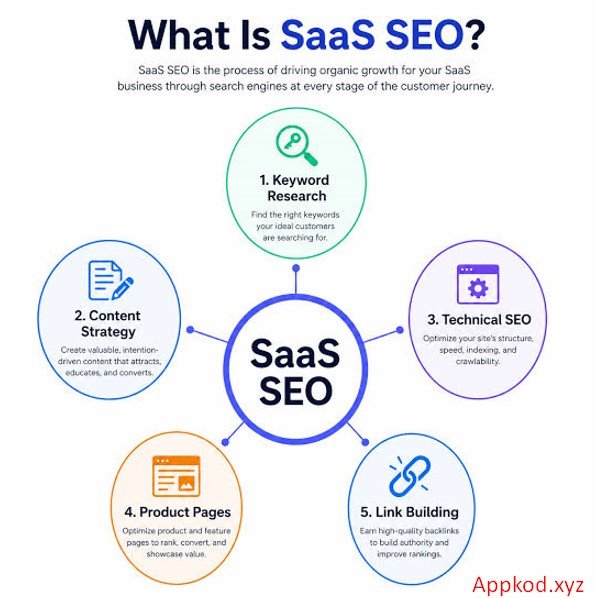
Their work usually blends three disciplines:
- Technical SEO for fast-loading, crawlable, well-structured product and marketing sites
- Content strategy built around buyer intent, not just keyword volume
- Conversion-focused optimization that turns organic visitors into trial users or demo requests
The goal isn’t just traffic. It’s qualified pipeline — visitors who are close enough to a buying decision that your sales or product team can convert them.
Why SaaS SEO Is Different From Traditional SEO
Many marketing leaders assume SEO is SEO, regardless of industry. That assumption costs SaaS companies real money. Here’s why the playbook changes.
The Buyer Journey Is Longer and More Layered
A SaaS purchase often involves a champion, a manager, and sometimes procurement or IT security. Content has to speak to each of these audiences differently, from technical documentation to executive-level ROI arguments.
Search Intent Is Split Across the Funnel
SaaS buyers search everything from broad problem-aware terms (“how to manage remote teams”) to narrow, bottom-funnel comparisons (“[Competitor] alternatives”). A strong agency maps content to each stage instead of only chasing high-volume keywords.
Product-Led Growth Changes the Metrics
Many SaaS companies now measure SEO success by trial signups or product-qualified leads, not just rankings. This requires close collaboration between the SEO team and product marketing.
Competitive Keywords Are Brutal
Software categories are crowded. Ranking for “[category] software” often means outranking companies with seven-figure marketing budgets. Agencies without SaaS experience frequently underestimate this difficulty.
Content Must Reflect Real Expertise (EEAT)
Google’s Helpful Content guidance rewards Experience, Expertise, Authoritativeness, and Trustworthiness. For SaaS, that means content written or reviewed by people who actually understand the product category, not generic AI-generated filler.
What a Good SaaS SEO Agency Actually Does

A strong SaaS SEO partner typically delivers a mix of the following services.
1. Technical SEO Audits
This includes site speed, crawlability, indexation, structured data, and Core Web Vitals. SaaS sites often have complex architectures — help centers, blogs, docs, and marketing pages — that need to work together technically.
2. Keyword and Topic Research
Good agencies research not just search volume, but buying intent. They separate keywords into categories:
- Top-of-funnel (educational)
- Middle-of-funnel (comparison, evaluation)
- Bottom-of-funnel (product, pricing, “best [category] tools”)
3. Content Strategy and Production
This covers blog articles, comparison pages, alternative pages (“[Your Product] vs [Competitor]”), use-case pages, and sometimes help documentation SEO.
4. Link Building and Digital PR
Backlinks remain a strong ranking signal. SaaS agencies often build links through guest posts, data-driven PR campaigns, partnerships, and product-led link building (like free tools or calculators).
5. Conversion Rate Optimization (CRO)
Traffic without conversions doesn’t grow revenue. Many SaaS SEO agencies test page layouts, calls-to-action, and trial signup flows to increase the percentage of visitors who convert.
6. Reporting Tied to Business Metrics
The best agencies report on pipeline and revenue influence, not just rankings and traffic. This means integrating with tools like HubSpot, Salesforce, or product analytics platforms.
Signs You Need a SaaS SEO Agency
Consider hiring a specialized agency if you notice any of these situations:
- Your organic traffic has plateaued for several months despite publishing content
- Competitors consistently outrank you for branded and category keywords
- Your blog gets traffic, but it rarely converts into trials or demos
- You don’t have in-house technical SEO expertise
- Your content team is stretched thin producing SEO content alongside product marketing
- You’re entering a new market or launching a new product line
If you’re only seeing one or two of these signs, an in-house hire or freelancer might suffice. Multiple signs usually indicate a broader strategic gap that an experienced agency can close faster.
How to Evaluate a SaaS SEO Agency

Before signing any contract, run each candidate through this evaluation process.
Step 1: Review Their SaaS Portfolio
Ask for case studies from companies similar to yours in size, business model, or category. An agency that has only worked with local businesses may not understand SaaS buying cycles.
Step 2: Ask About Their Process
A credible agency should explain, in plain language, how they research keywords, plan content, and measure success. Vague answers are a warning sign.
Step 3: Check How They Define Success
Ask directly: “What metrics do you report on, and how do they tie to revenue?” Agencies fixated only on rankings and traffic often miss the bigger picture.
Step 4: Evaluate Their Own SEO
If an agency can’t rank its own website for competitive terms in its niche, be cautious. This isn’t always disqualifying, but it’s worth asking about.
Step 5: Ask About Team Structure
Find out who will actually work on your account — strategists, writers, technical specialists — and whether work is outsourced to freelancers with no oversight.
Step 6: Understand Their Content Approach
Ask how they ensure content meets EEAT standards and Google’s Helpful Content guidelines. This matters more than ever, since generic AI-written content without expert review tends to underperform.
SaaS SEO Agency vs. In-House Team vs. Freelancer

| Factor | SaaS SEO Agency | In-House Team | Freelancer |
| Cost | Medium to high, but scalable | High (salaries, tools, benefits) | Low to medium |
| SaaS expertise | Usually specialized | Depends on hire | Varies widely |
| Speed to results | Faster, established process | Slower to ramp up | Depends on availability |
| Scalability | Easy to scale services up or down | Requires new hires | Limited by one person’s capacity |
| Range of skills | Full team (technical, content, links, CRO) | Limited to hired skill sets | Usually one specialty |
| Long-term cost efficiency | Strong for growth-stage companies | Strong for large, mature teams | Best for small, defined projects |
| Oversight required | Moderate | Low (direct management) | High (needs clear direction) |
There’s no universally “best” option. Early-stage startups with limited budgets sometimes start with a freelancer, then transition to an agency once growth demands more consistent output.
Red Flags to Watch For
Not every agency calling itself a “SaaS SEO agency” actually understands SaaS. Watch for these warning signs.
- Guaranteed rankings. No ethical agency can guarantee a #1 ranking. Search algorithms change too often for anyone to promise specific positions.
- Cookie-cutter proposals. If the strategy looks identical to what they’d pitch a dentist or a restaurant, it probably is.
- No transparency on tactics. Agencies that won’t explain their link-building sources may be using risky, spammy tactics that can trigger Google penalties.
- Overemphasis on volume, not quality. Ten mediocre articles a month rarely outperform two well-researched, expert-reviewed pieces.
- No mention of Core Web Vitals or technical SEO. Content alone can’t fix a slow, poorly structured site.
- Vague reporting. If you can’t tell how their work affects trials, demos, or revenue, the reporting isn’t doing its job.
Pros and Cons of Hiring a SaaS SEO Agency
Pros
- Access to a full team of specialists instead of one generalist
- Faster ramp-up than building an in-house function from scratch
- Exposure to SaaS-specific best practices learned across multiple clients
- Easier to scale services during growth phases
- Reduces the burden on internal marketing teams
Cons
- Can be more expensive than a single freelancer, especially short-term
- Requires clear communication to align with your product and brand voice
- Some agencies subcontract work, which can reduce quality control
- Results typically take three to six months to show meaningfully
- Switching agencies later can create strategy continuity issues
What Results to Realistically Expect
SEO is not a paid ad campaign — it doesn’t produce instant traffic spikes. Most SaaS companies should expect the following general timeline, though results vary by competition level, domain authority, and starting point:
- Months 1–3: Technical fixes, keyword research, and initial content published
- Months 3–6: Early ranking movement for lower-competition keywords
- Months 6–12: Meaningful traffic growth and early trial or demo conversions from organic search
- Beyond 12 months: Compounding growth as content authority and backlinks accumulate
Any agency promising major results in 30 days is either inexperienced or not being fully honest about how search algorithms work.
Frequently Asked Questions
1. How much does a SaaS SEO agency cost?
Most SaaS SEO agencies charge between $3,000 and $20,000 per month, depending on scope, team size, and company stage. Enterprise-level engagements can run higher.
2. How long does SaaS SEO take to show results?
Most companies see initial movement within three to six months, with stronger growth after six to twelve months of consistent execution.
3. Is SEO still worth it for SaaS companies in 2026?
Yes. Even with AI search tools changing how people find information, organic search remains a major discovery channel for software buyers researching solutions.
4. What’s the difference between SaaS SEO and B2B SEO?
SaaS SEO is a subset of B2B SEO, but it specifically accounts for trial-based funnels, freemium models, and product-led growth metrics that other B2B businesses may not use.
5. Should I hire a local SEO agency instead?
Local agencies typically lack experience with SaaS buyer journeys and competitive software keywords. A specialized SaaS SEO agency usually delivers better results for software companies.
6. Can a SaaS SEO agency help with product-led growth?
Yes. Many agencies now design content and landing pages specifically to drive trial signups and free-tool usage, aligning SEO directly with product-led growth strategies.
7. Do SaaS SEO agencies handle content writing?
Most do, either with in-house writers or vetted freelancers who understand the software category. Always ask how they ensure content accuracy and EEAT compliance.
8. What’s the difference between SEO and content marketing for SaaS?
SEO focuses on search visibility and technical optimization, while content marketing is the broader strategy of creating valuable material. A SaaS SEO agency typically manages both together.
9. How do I measure ROI from a SaaS SEO agency?
Look beyond rankings and traffic. Track organic-driven trial signups, demo requests, and eventually closed revenue attributed to organic channels.
10. Can small SaaS startups afford an SEO agency?
Some agencies offer scaled-down packages for early-stage startups. Alternatively, startups can start with a freelancer and transition to an agency as budget allows.
Conclusion
Choosing a SaaS SEO agency is a strategic decision, not just a marketing expense. The right partner understands your buyer’s journey, speaks the language of trials and product-qualified leads, and builds content that reflects real expertise rather than generic filler.
Before signing any contract, review case studies, ask detailed process questions, and make sure their reporting connects directly to pipeline and revenue — not just rankings. SEO takes time, but with the right agency, it becomes one of the most durable, cost-effective growth channels a SaaS company can build.